
Seeing default coming: what 3,700 corporate failures teach lenders about early warning
Research from the credit analytics team at Cyte and Anchor Point Risk: what 900 recent corporate failures — set against a 45-year, 3,674-defaulter record — tell you about spotting trouble early in a corporate credit book.

Research from the credit analytics team at Cyte and Anchor Point Risk: what 900 recent corporate failures — set against a 45-year, 3,674-defaulter record — tell you about spotting trouble early in a corporate credit book.
Why we did this research
At Cyte we build and maintain IFRS 9 credit risk frameworks for lenders. One of the most consequential settings in any such framework is the Significant Increase in Credit Risk (SICR) trigger — the rule that decides when an exposure moves from Stage 1 to Stage 2 and provisioning jumps from 12-month to lifetime expected credit losses. Set it too loose and deterioration is recognised late; too tight and provisions whipsaw with every downgrade. Yet at many institutions these triggers were calibrated once, at IFRS 9 adoption, and have not been re-evidenced since — which means they are calibrated to a pre-COVID world.
That is not how we think calibration should work. When S&P Global published its 2025 Annual Global Corporate Default and Rating Transition Study in March 2026, our research team put our own framework on the bench: we extracted every publicly rated defaulter from eight years of annual studies (2018–2025), rebuilt the trigger derivation from scratch on the pooled 702-name dataset, and back-tested the framework against the 2025 defaulted population. The calibration held — the evidence for that sits in our working papers. But the dataset also told a bigger story about how corporate failure announces itself, and those findings are worth sharing beyond our audit files. Five of them follow.
1. Defaults are falling — but the cycle is not over
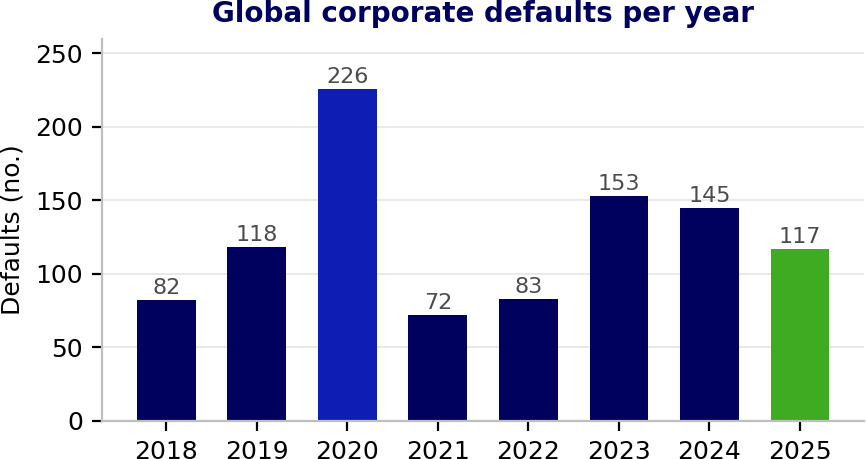
Global corporate defaults declined for a second consecutive year to 117 in 2025, down 19% from 145 in 2024 and far below the pandemic peak of 226. Credit quality broadly improved: 9.4% of issuers were upgraded in 2025 against 5.6% downgraded. But the composition of defaults should temper any comfort. Distressed exchanges — debt restructurings that crystallise losses without a formal bankruptcy — accounted for 58% of 2025 defaults. Lenders are increasingly being asked to accept impaired terms long before a payment is ever missed, which means default risk is arriving through the back door of consensual restructuring rather than the front door of arrears.
2. Ratings still rank-order risk with remarkable power
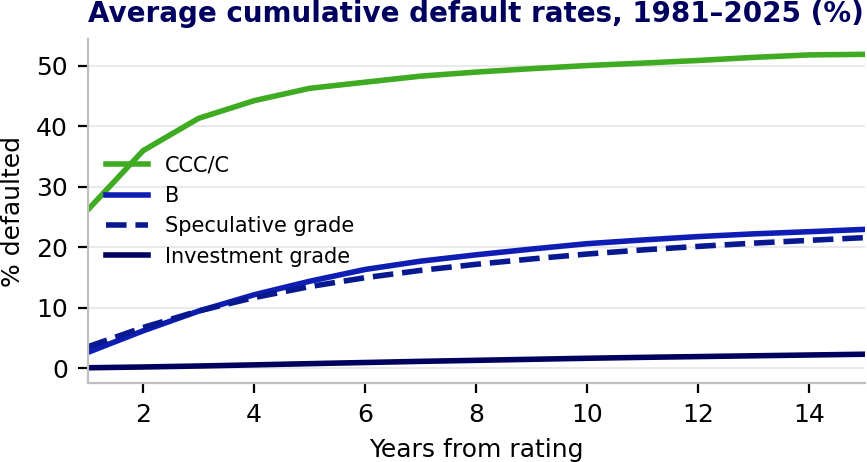
Over the full 1981–2025 record, roughly a quarter of CCC/C-rated companies default within one year and half within ten. B-rated issuers reach a 23% cumulative default rate over 15 years against just 2.3% for investment-grade names — a tenfold difference. The rank-ordering power of a well-calibrated rating scale remains the single most reliable early-warning instrument available to a lender.
3. The warning window slams shut as credit deteriorates
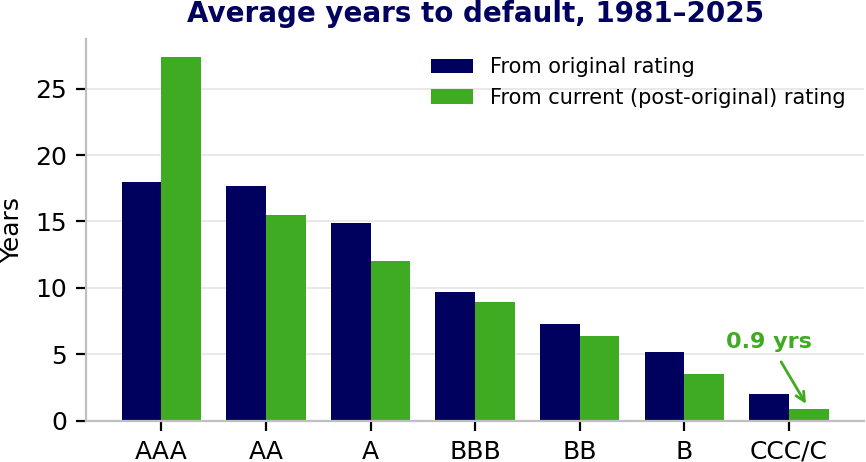
A company originally rated BBB that eventually fails takes almost a decade to do so, on average. One rated B takes five years. But once a name migrates into the CCC/C category, the average remaining time to default is just 0.9 years — and the median a mere five months. For a lender, the practical implication is stark: by the time a counterparty carries a CCC-equivalent internal grade, the time available to restructure security, reduce limits or exit has largely evaporated.
4. Most defaulters telegraph their failure — if you track migration
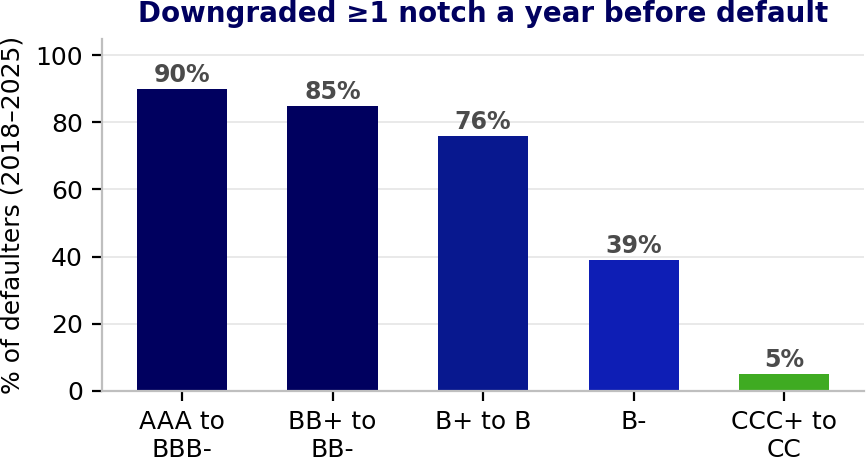
Across the 702 defaulters we analysed from the 2018–2025 studies, 90% of those originally rated investment grade had already been downgraded at least one notch a full year before they defaulted, as had 85% of BB-originated and 76% of B+/B-originated names. Rating migration — not arrears — is the dominant observable warning. A counterparty that misses payments has usually been signalling through its risk grade for years.
5. The weakest credits give the least warning
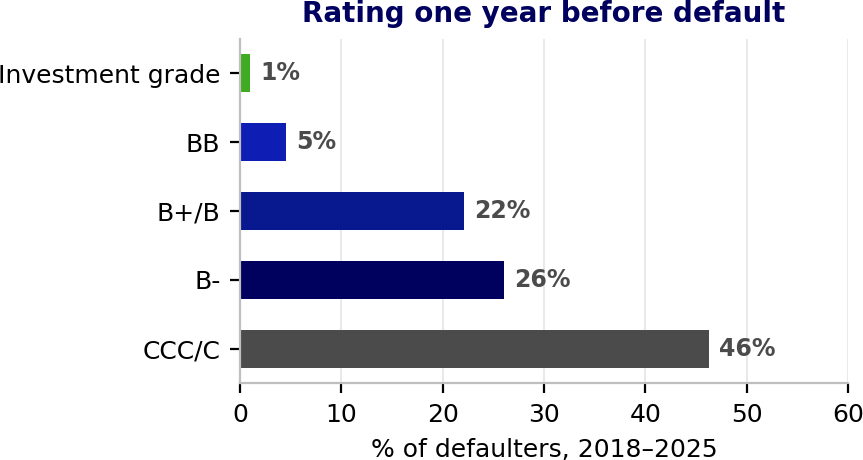
The migration signal has a blind spot. One year before default, 46% of defaulters already sat in the CCC/C band and a further 26% at B-. Names that start life at the bottom of the scale rarely show a further downgrade before failing — only 5% of CCC-originated defaulters were downgraded again before default, simply because there is nowhere left to go. For these exposures, notch-based triggers add little; monitoring must shift to liquidity indicators, covenant performance, payment behaviour and days-past-due backstops.
What this means for corporate lenders
- Track notch migration from origination, not just point-in-time grades. The distance a counterparty has travelled since you priced the deal is the strongest single default signal — our analysis supports graduated triggers of 4 notches for investment-grade originations down to 1 notch for B- and below.
- Treat CCC-equivalent grades as an automatic escalation. With 0.9 years of average runway, waiting for arrears forfeits most of your recovery options.
- Watch for distressed exchanges. A majority of modern defaults arrive as restructuring proposals; treat any request to amend terms under stress as a default-risk event in your staging and provisioning.
- Layer your signals. Migration triggers capture roughly half of defaults a year in advance; combine them with qualitative triggers and 30/90 days-past-due backstops for full coverage — the architecture IFRS 9 SICR frameworks are built on.
When was your SICR framework last recalibrated?
If your staging triggers were set at IFRS 9 adoption and have not been re-evidenced against post-COVID default data, they are due a health check. Cyte’s research team runs the analysis behind this article — trigger back-testing, re-derivation on current default data and audit-ready working papers — as a standard part of our SICR framework reviews. We also provide ratings and dual PIT/TTC probability-of-default benchmarks as a cost-effective alternative to traditional providers. For an independent review of your framework, contact admin@cyte.co.za.