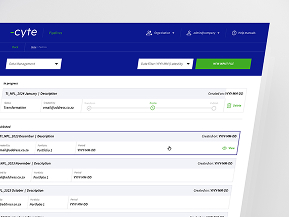

Risk Suite

Compliance

Governance, auditability and regulatory alignment by design.

Explore our models

Model

SME PD & LGD Model (South Africa & Emerging Markets)

Designed to unlock access for small and medium enterprises, including thin-file entities with limited history.

  • Produces Probability of Default (PD) and Loss Given Default (LGD) for SME exposures.
  • Calibrated to South African and wider emerging-market datasets.
  • Supports affordability checks and portfolio-level SME impairment forecasting.
  • Enables lenders and DFIs to extend credit where traditional scoring fails.
Model

Large Corporate PD & LGD Model (RiskCalc-aligned)

Built for multinationals and diversified corporates using financial statement ratios and global benchmarks.

  • Aligned to RiskCalc-style methodology and global benchmarks.
  • Produces PD & LGD suitable for IFRS 9 ECL and Basel capital calculations.
  • Handles complex group structures and multi-year comparative analysis.
  • Provides supportable ratings for internal approval and external investors.
Model

Global Bank PD/LGD Model

Tailored for regulated banks and deposit-taking institutions, covering PD, LGD, and Exposure at Default (EAD).

  • Covers PD, LGD, and Exposure at Default (EAD).
  • Aligned to external credit rating agency conventions, feeding directly into capital adequacy and RWA reporting.
  • Can be calibrated to local supervisory requirements while retaining global comparability.
  • Designed for governance-ready, explainable outputs.
Model

Global NBFI PD Model

For non-bank financial institutions (e.g., micro-lenders and specialty finance companies) producing PDs tailored to regulated but non-bank lenders.

  • Produces PDs tailored to regulated but non-bank lenders.
  • Benchmarked to global NBFI data and integrated with affordability rules.
  • Often paired with finance company / fintech workflows for rapid origination and approvals.
  • Governance-ready calibration and monitoring.
Model

Project Finance LGD Model

Purpose-built for infrastructure and renewable energy projects with long horizons, modelling LGD through cashflow waterfalls and stress overlays.

  • Models LGD through cashflow waterfalls, collateral stresses, and political overlays.
  • Sector-specific calibration curves for energy, transport, housing, and mining.
  • Aligns with DFI and blended-finance investor requirements.
  • Produces recovery distributions, not just default probabilities.
Model

Commercial Real Estate (CRE) PD & LGD Model

Developed for property portfolios and real estate exposures, assessing tenant quality, lease terms, collateral, and sector cycles.

  • Assesses tenant credit quality, lease terms (WALE), collateral, and sector cycles.
  • Produces PD and LGD for individual CRE exposures or whole portfolios.
  • Supports IFRS 13 fair value, impairment testing, and Basel CRE slotting approaches.
  • Built for portfolio monitoring and valuation governance.
Model

Hazard-Rate Consumer PD Model (IFRS 9)

A top-down, actuarial model for consumer/retail portfolios supporting IFRS 9 ECL compliance for large retail books.

  • Uses migration and development factor approaches to forecast PDs.
  • Supports IFRS 9 Expected Credit Loss (ECL) compliance for large retail books.
  • Designed for continuous monitoring and trend detection (moving-window hazard rate).
  • Built for governance-ready backtesting and sensitivity analysis.

Explore our credit risk suite

IFRS 9 tools

IFRS 9 tools that standardise impairment calculations, strengthen provisioning accuracy, and ensure compliant credit-loss reporting.

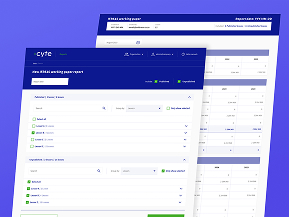
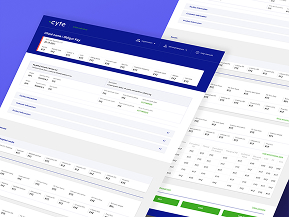
Cyte’s IFRS 9 framework automates expected credit-loss (ECL) calculations across performing and non-performing exposures using integrated PD, LGD, and EAD inputs. Operations teams benefit from fast, consistent impairment processing; portfolio managers gain consolidated insights into provisioning impacts and risk migration; and compliance officers receive regulator-aligned disclosures with full audit trails. With IFRS 9, organisations maintain accurate, defensible provisioning practices and forward-looking risk assessments grounded in validated model outputs.

IFRS 13 Valuation

IFRS 13 tools that deliver consistent fair-value measurements, transparent valuation methodologies, and audit-ready reporting.

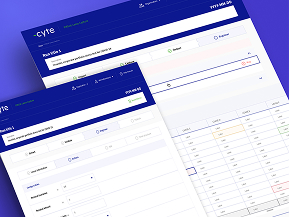
Cyte’s IFRS 13 framework centralises debt, guarantee, and collateral valuations using standardised, income-based and credit-risk-based methodologies. Risk teams can validate fair-value outputs at instrument level; portfolio managers gain insight into pricing alignment, yield, and margin performance; and compliance teams receive disclosure-ready valuation reports supported by traceable inputs. With IFRS 13, organisations maintain defensible, market-aligned fair-value measurements across their portfolios.

IFRS 16 tools

IFRS 16 tools that automate lease accounting, ensure accurate exposure measurement, and deliver regulator-ready disclosure outputs.

Cyte’s IFRS 16 framework streamlines the capture, calculation, and reporting of lease-related exposures across large portfolios. The platform automates right-of-use asset recognition, lease liability calculations, amortisation, and depreciation schedules using standardised methodologies. Operations teams gain efficient, error-free lease processing; managers receive clear visibility into lease exposures and financial impacts; and compliance officers benefit from accurate disclosure templates and integrated audit trails. With IFRS 16, organisations maintain consistent, defensible lease reporting across all entities and reporting cycles.

Basel tools

Basel tools that strengthen capital adequacy oversight, enhance portfolio transparency, and ensure alignment with regulatory capital requirements.

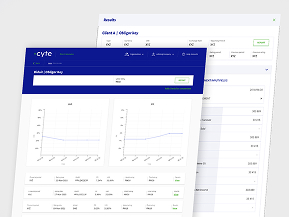
Cyte’s Basel framework supports banks, NBFIs, and credit providers in calculating risk-weighted assets (RWA) and capital adequacy ratios using PD, LGD, and EAD inputs derived from Cyte’s rating models. Risk teams can assess capital consumption at obligor and portfolio level, managers gain visibility into capital efficiency across exposures, and compliance teams receive regulator-aligned outputs with clear model governance. With Basel tools, organisations ensure that capital allocation, provisioning, and risk appetite remain aligned - supported by transparent, validated, and auditable methodologies.

AML/KYC tools

AML/KYC tools that standardise client verification, enforce policy, and ensure every credit decision meets regulatory compliance requirements.

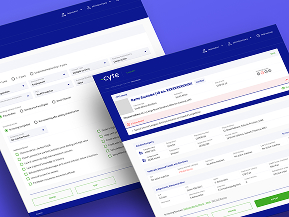
Cyte’s AML/KYC compliance capabilities integrate affordability scoring, identity verification, and rule-based policy checks into a single, consistent workflow. The Decision Engine ensures KYC and AML decisions are standardised, traceable, and policy-aligned, while producing complete audit logs for regulatory reviews. Operations teams gain efficiency through automated verification steps, portfolio managers benefit from consistent compliance enforcement across clients and segments, and compliance officers receive defensible evidence trails that meet regulatory expectations. With AML/KYC, organisations reduce compliance risk while maintaining fast, accurate credit operations.

System governance and audit

Governance and audit tools that ensure transparency, traceability, and operational integrity across the entire credit lifecycle.

Cyte’s governance framework provides end-to-end oversight of system processes, data flows, and model execution. BootSure Pipelines orchestrate background tasks with full logging and execution histories; Digital Pipelines maintain complete data lineage from extraction to transformation; and all actions across the Suite are tracked for audit and regulatory evaluation. Operations teams gain workflow transparency, managers receive consistent and reliable system outputs, and compliance officers benefit from an auditable environment where every model run, data mapping, and decision is fully documented and traceable.

Seamless integration

Seamless integration

  • Powered by BootSure – automation engine orchestrating data ingestion and model execution across Cyte modules.
  • API-first architecture ensures low-friction deployment.
  • Enterprise connectors link to banking, insurance, finance systems.
  • Digital pipelines transform unstructured data into model-ready inputs.
  • White-labelling ensures each client instance carries their own brand.
Integrated AI

AI that evolves with your business.

  • Intelligent Capture: automates statement and lease extraction with high accuracy.
  • Smart Decisioning: affordability, pricing, and approvals guided by AI.
  • Predictive Insights: portfolio foresight on impairments and PD/LGD shifts.
  • Always Learning: models adapt as your data grows.
Enterprise-grade security

Enterprise-Grade Security

  • End-to-end encryption standards.
  • Compliance with POPIA (South Africa), GDPR (EU), and global protocols.
  • Continuous monitoring, logging, resilience testing.
Consultation

Master compliance, elevate portfolio performance, and transform credit operations – all in one platform.

  • Regulator-ready compliance
  • Portfolio intelligence
  • Operational excellence